

Moving African Oil: Cross-Border Pipeline Soon To Open With First Oil Expected Next June
The inauguration of the 1,447-kilometer East African Crude Oil Pipeline (EACOP), stretching from Uganda’s Lake Albert area to Tanzania’s Tanga Port, has been long in the making, but now stands at over 98% complete. That is the metric provided to FORBES AFRICA by Uganda National Oil Company’s (UNOC) Chief Corporate Affairs Officer, Tony Otoa, who, …
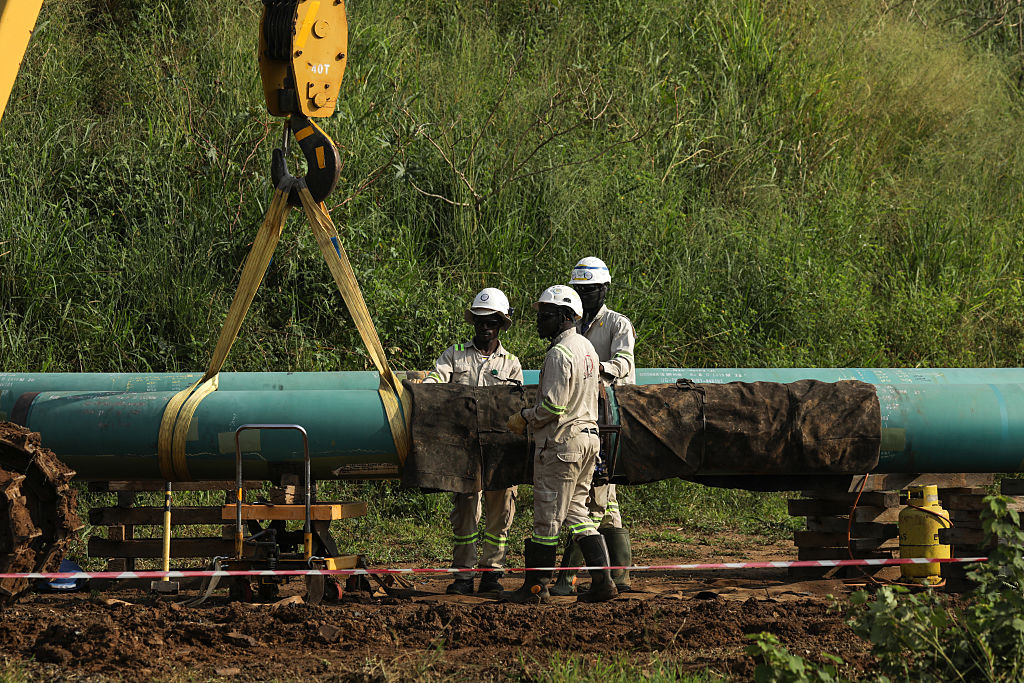
The inauguration of the 1,447-kilometer East African Crude Oil Pipeline (EACOP), stretching from Uganda’s Lake Albert area to Tanzania’s Tanga Port, has been long in the making, but now stands at over 98% complete.
That is the metric provided to FORBES AFRICA by Uganda National Oil Company’s (UNOC) Chief Corporate Affairs Officer, Tony Otoa, who, on the sidelines of Africa Energy Week–which took place in Cape Town from October 12-16–reveals it to be “good to go by the end of the year”.
Further reports indicate that while the pipeline will be ready to receive crude mid-December, first commercial oil production is expected to be around June 2027.
EACOP’s arrival will come “despite all of the issues we faced in the beginning with funding and climate change activists stalling the project,” Otoa admits.
Per an Earth Insight report from May 2026, data showed that 84% of the pipeline network intersects with antelope habitat, 22% with leopard habitat, 17% of it intersects with giraffe habitat and 67% intersects with monkey habitat.
“Transparency about the EACOP’s full life-cycle impact on interconnected cultures and ecosystems over the next 30 years and beyond can prevent irreversible, long-term harm,” Earth Insight wrote on its website.
The project attracted $4 billion in capital investment, according to the official EACOP website, making it responsible for what it believes to be “one of the largest ever inward investments into Uganda and Tanzania”.
Assess the 24-inch-wide carbon steel pipe in person, and you may liken it to generic industrial piping. Learn of its high-tech interior, however, and you’ll understand why there’s a lot more than meets the eye.
Fiber optic cables and an advanced detection and analytical system are embedded in the cross-border conduit, designed to deliver early detection alerts of potential landslides in sloped areas, as well as, alongside additional benefits, notify of any human intrusions and temperature variations indicating possible pipeline exposure or leaks.
The oil, described as “waxy” and like “shoe polish” by Otoa, demanded more engineering innovation.
To melt the commodity for long-distance travel, the entire pipeline will be heated above 50 degrees Celsius as the oil journeys through “six pumping stations…some of these stations will have heating points” for continuous flow, he adds.
After EACOP’s upcoming inauguration, Otoa confirms administrative intentions to build an “energy hub” in Tanga, equipped with another pipeline to transfer “finished product back into Uganda”.
Snaking through 10 districts in Uganda and eight regions in Tanzania, it not only presents the nations with an opportunity to improve their and the region’s energy security, but, with a peak capacity of 246,000 barrels per day (bbls/day), its access to international markets via Tanga Port makes it an notable export prospect.
The Daily Brief
Get the daily FORBES.NG briefing.
Comments (0)
Sign in to join the conversation.
Related Stories
Malawi 2026: Charting A New Development Path
For decades, Malawi’s economic promise has been easy to identify and harder to unlock. The country has fertile land, a young population, mineral resources, tourism assets, and access to a regional market far larger than its own. The challenge has been turning those advantages into production at scale. In 2026, that question sits at the …

‘Pleased To Join All Those Who Support International Justice’: South Africa’s First Female Nobel Peace Prize Laureate On Upholding The Rule Of Law
It’s a busy Monday afternoon for the world’s newest Nobel Peace Prize laureate, who is taking back-to-back press interviews from her desk at The Hague, the Netherlands’ seat of international law and arbitration. Navanethem ‘Navi’ Pillay was at an international conference in the Nuremberg Palace of Justice–more specifically, in the historic Courtroom 600, where Nazi …
More from Freddie Hiney
Zambia Prepares For El Niño After Previous Droughts Triggered Blackouts
The drought over two years ago had catastrophic consequences for Zambia’s energy security–a nation largely dependent on hydropower, generating over 80% of its electricity, according to government figures. As rivers dried up, the number of blackouts rose. The arriving El Niño—widely expected to become one of the strongest on record and anticipated to grapple the …

‘Thinking Five Years Ahead’: Ethiopia’s $50 Million Bet To Become Billion-Dollar Regional Gold And Metals Hub
Inaugurated on October 10, Ethiopia’s National Precious Metals Refinery coincides with gold’s rising importance for the nation of nearly 140 million people. According to the National Bank of Ethiopia, gold exports rose from $133.6 million in the fourth quarter (Q4) of 2023/24 to $1.29 billion in Q4 2024/25. Welcomed as Ethiopia’s first gold refinery, and …
Interest Rate Rises In South Africa, Experts Evaluate Possibility Of Recession
The financial toll of the ongoing global energy crisis is becoming increasingly apparent for Africa’s biggest economy. On Thursday, the South African Reserve Bank (SARB) announced its decision to increase the interest rate by 25 basis points to 7%, a week after year-on-year head inflation hiked to 4%, up from 3.1% in March. Offering some …
Recommended



The Daily Brief