

‘Pleased To Join All Those Who Support International Justice’: South Africa’s First Female Nobel Peace Prize Laureate On Upholding The Rule Of Law
It’s a busy Monday afternoon for the world’s newest Nobel Peace Prize laureate, who is taking back-to-back press interviews from her desk at The Hague, the Netherlands’ seat of international law and arbitration. Navanethem ‘Navi’ Pillay was at an international conference in the Nuremberg Palace of Justice–more specifically, in the historic Courtroom 600, where Nazi …
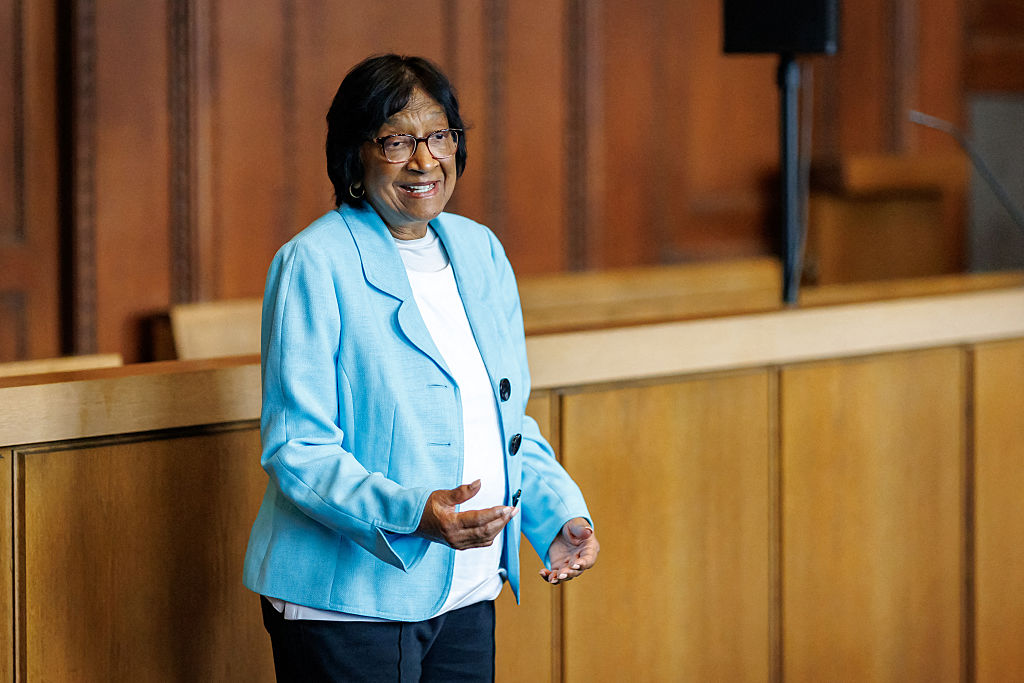
It’s a busy Monday afternoon for the world’s newest Nobel Peace Prize laureate, who is taking back-to-back press interviews from her desk at The Hague, the Netherlands’ seat of international law and arbitration.
Navanethem ‘Navi’ Pillay was at an international conference in the Nuremberg Palace of Justice–more specifically, in the historic Courtroom 600, where Nazi leaders were tried after World War II–in Germany, when she received the “surprising” news and her “peers” gave her a standing ovation.
The award comes in the 125th year of the Nobel Peace Prize. For the South African human rights lawyer and judge, the honor carries particular historical weight at home. While she joins an eminent pantheon of famous Africans who have previously won the award, including Kofi Annan, Albert Luthuli, Nelson Mandela, Desmond Tutu, Ellen Johnson Sirleaf and Wangari Maathai among others, she is the fifth South African and first South African woman to be awarded the Nobel Peace Prize.
It was a moment of disbelief for her when the news came, as she became only the 21st woman in the world to win the coveted prize.
Soon after, Kristian Berg Harpviken, the Director of the Norwegian Nobel Institute, called her to formally announce the win, and Pillay told him: “I know it’s a personal award, but for me, mainly, it’s for all the institutions I served on as well; all the people I worked with as well.”
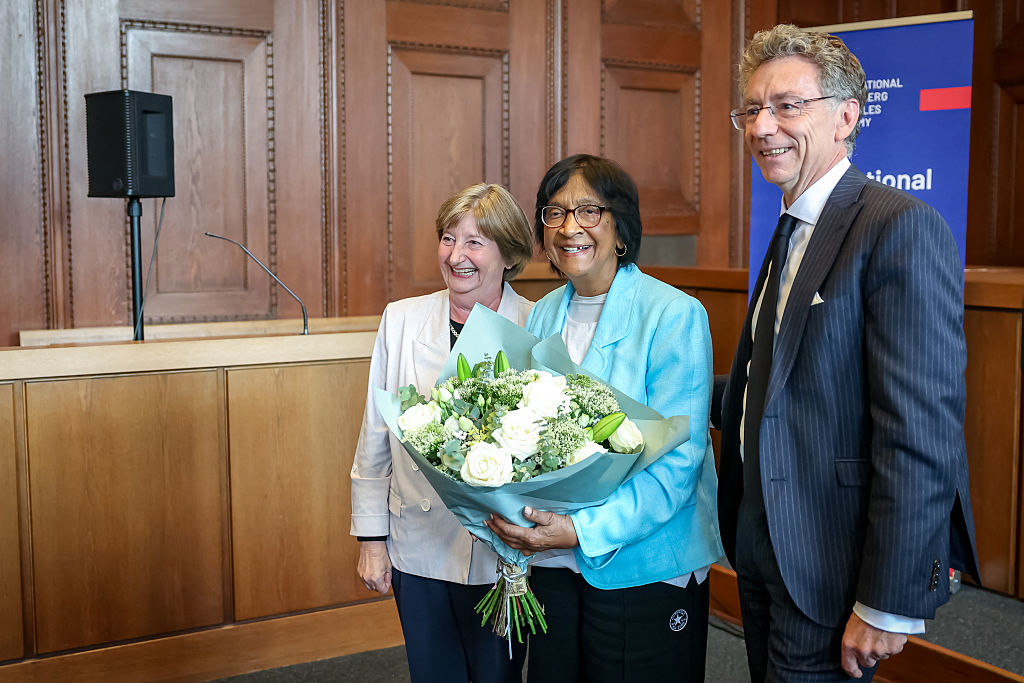
“It still hasn’t sunk in,” says Pillay, who turned 85 last month, to FORBES AFRICA, on a Zoom call from The Hague, 10 days since the announcement of the award on October 9.
“Over the weekend, I spent two days in Amsterdam and was greeted in restaurants and by the people on the street. They recognized me for the award and I received many congratulations. It’s really heartwarming…
“It’s wonderful for so many reasons, but mainly because the world now really needs to get to grips on making sure that we have justice and peace.”
The Norwegian Nobel Committee called her a person “who with exceptional courage and integrity has led the way towards a more comprehensive global legal order”. It attached importance to Pillay’s role as a driving force in the development of an international system of law and order.
“At a time when the number of wars and conflicts is rising, and when judges and institutions of international law are under political attack, the Nobel Committee wishes to issue a reminder that the ability to resolve conflicts without force or violence is dependent on the international rule of law,” the Committee added.
Pillay acknowledges that these are extremely challenging times and it’s rarely that international jurists receive global recognition of this stature. “They don’t usually give awards to judges and lawyers and they’ve given very few awards to women,” she attests.
“I don’t wish to be the exception or the exceptional woman,” says Pillay during the interview. “There are so many of us and we are bypassed because they don’t think of us, just like they don’t think of people of color when it comes to these awards… But I welcome the change, that the committee looked further into not only my personal contribution and my life’s work, but also that was always advancing justice through institutions such as the International Criminal Court (ICC).”
Pillay served as a judge and later president of the International Criminal Tribunal for Rwanda, elected by the United Nations (UN) General Assembly, and after that, from 2003 to 2008, as a judge at the ICC, established in 2002 to prosecute individuals accused of war crimes, crimes against humanity and genocide. She was later appointed the UN High Commissioner for Human Rights, and in 2019, became an ad hoc judge at the International Court of Justice (ICJ). She also chaired the UN Independent International Commission of Inquiry on the Occupied Palestinian Territory from 2021 to 2025, and is currently a member of the Advisory Council of the International Nuremberg Principles Academy in Germany.
It has been a long illustrious career with her work on the bench seeing many firsts. In 1967, she became the first non-White woman to start her own law practice in South Africa’s Natal province at the height of the apartheid era. A year after the country became a democracy, in 1995, she became the first woman of color to become a judge in South Africa’s High Court.
Recalling her association with Mandela, South Africa’s then president, she says: “He was really in many ways such a good example for us… A great model.”
‘My grandfather predicted I would become a lawyer’
A bus driver’s daughter raised in the Indian suburb of Clairwood in Durban, Pillay began her human rights work in a segregated South Africa. Harking back to her childhood, she refers to what may have been defining moments that sealed her destiny as a lawyer.
“My paternal grandfather was brought by the British from India to work in the sugarcane plantations. His arms were accidentally chopped off by the equipment . I always remember him wearing a dhoti (traditional men’s sarong) and long coat. He predicted that I would become a lawyer someday. It became a family joke. But I stored it somewhere in my mind,” recollects Pillay.
In the first year of high school, when Pillay’s teacher asked what she would like to be when she grew up, she said without hesitation: “I’m going to be a lawyer.”
“And my teacher said ‘well, your father must be very rich’. You needed a lot of money to study law , which totally crushed me, but I didn’t give up the fact that that is what I wanted to do; to fight for justice through the rule of law.”
Long before any of this, at age five, she had her first brush with a courtroom, testifying as a witness after she was robbed. Years later, she would return to that same room as a practising lawyer.
It’s a memory she comes back to, eyes shining.
“My mother had given me five pounds–my father’s salary for the entire month . He had sent a message through his conductor to bring the money to him, to buy live chickens. My mother was reluctant to hand it to the conductor, so she put the money in my hands and said ‘make sure you give it to your father’. But as we walked along the road, the conductor wrenched the money from my hand and ran away. My father chased after him in his car.”
Eventually, the case ended up in court, and the offender was imprisoned for three months. “I asked my father ‘did we get the money back?’ He said ‘no, but I’m very proud you spoke up in court’. I left that court really unhappy because you know, as a child, I blamed myself for the loss of the money. But let me tell you that years later, I stood in that courtroom as a lawyer fighting cases. And then, when I became the first woman of color to be a judge, I sat in that same courtroom.”
‘Support the cause of the rule of law’
As a judge serving in numerous international courts, working to strengthen the institutions of law, committed to justice and human rights, there has been great applause but also strong criticism.
Israel sharply criticized Pillay’s Nobel Peace award, and hours after the announcement, the Trump administration reportedly imposed fresh sanctions on the ICC, cutting off its resources.
You ask Pillay how she handles it, fearlessly, and with conviction. She throws back to her work in South Africa during the apartheid era.
“Like many South Africans fighting racism and racial oppression, we felt we were on the moral right and that the world’s people supported our struggle. I always went with that sense of support, giving my support and voice to what is right…
“In all the cases that I sat, I did so as a judge, and as you know, all judges look at the evidence. , the acts against people, like the Rwanda genocide, we look at statements made by leaders. So, it’s a very mechanical, thorough process and when the judges are not satisfied, they dissent, or they give their reasons–there are specific tools that guide them. There are exceptions I admit, but we do not act out our personal beliefs and prejudices.
“I am very pleased to join all those who support the cause of the rule of law, international justice and particularly the ICC.”
Durban-based peace activist and founder of the Natal Organisation of Women, Ela Gandhi, applauds Pillay, adding to FORBES AFRICA: “The award reminds me of the call made by Mahatma Gandhi 96 years ago for ‘world sympathy in this battle of right against might’, for, the award, in the midst of gross violations of human rights and use of indiscriminate violence against civilians by those armed with lethal weapons, is a reminder and a call to the world community to respect international instruments and uphold peace with justice.”
Pillay’s influence was a significant factor, the Nobel Peace Prize website also notes, when the International Criminal Tribunal for Rwanda established that rape and sexual violence could constitute a crime against humanity–as well as genocide.
“As we look at the current-day crises, whether it’s conflicts and warfare or economic crises, droughts and floods, it’s the women who suffer the most,” says Pillay on her enduring work fighting crimes against women. “It’s very important to ensure there’s equality for women. We have that in theory, in the law, but not in practice. And this is why I will continue to support the women whom I believe are still discriminated against and treated as victims. In my own country, in South Africa, the levels of rape and sexual violence and killings of women is just unconscionable now. So much so that the president has declared it a national disaster.”
On December 10 this year, Pillay will receive the peace prize in Oslo, Norway. What’s next?
“I’ve reached the end of the road, you know,” laughs the longstanding jurist. “I’m 85… Obviously, I will continue to play a role wherever I’m needed. People have said to me ‘when are you going to stop’. I tell them that I will stop when the human rights violations end.”
The Daily Brief
Get the daily FORBES.NG briefing.
Comments (0)
Sign in to join the conversation.
Related Stories

Malawi 2026: Charting A New Development Path
For decades, Malawi’s economic promise has been easy to identify and harder to unlock. The country has fertile land, a young population, mineral resources, tourism assets, and access to a regional market far larger than its own. The challenge has been turning those advantages into production at scale. In 2026, that question sits at the …
‘Pleased To Join All Those Who Support International Justice’: South Africa’s First Female Nobel Peace Prize Laureate On Upholding The Rule Of Law
It’s a busy Monday afternoon for the world’s newest Nobel Peace Prize laureate, who is taking back-to-back press interviews from her desk at The Hague, the Netherlands’ seat of international law and arbitration. Navanethem ‘Navi’ Pillay was at an international conference in the Nuremberg Palace of Justice–more specifically, in the historic Courtroom 600, where Nazi …
Where Continents Meet, Opportunity Begins
Tunisia’s talent, technology, and industrial strength redefine its role in the global economy. Tunisia has spent decades being described by where it sits. What defines it now is who lives there. A new generation of engineers, entrepreneurs, researchers, and industrial leaders is turning the country’s historic Mediterranean advantage into something more valuable: a place where …
More from Renuka Methil
‘Pleased To Join All Those Who Support International Justice’: South Africa’s First Female Nobel Peace Prize Laureate On Upholding The Rule Of Law
It’s a busy Monday afternoon for the world’s newest Nobel Peace Prize laureate, who is taking back-to-back press interviews from her desk at The Hague, the Netherlands’ seat of international law and arbitration. Navanethem ‘Navi’ Pillay was at an international conference in the Nuremberg Palace of Justice–more specifically, in the historic Courtroom 600, where Nazi …
Amadou Hott On Africa: ‘Create Jobs And Increase The Wealth For Ourselves’
In the running for one of the biggest jobs on the continent, Senegal’s Amadou Hott is no stranger to public life. As a former Minister of Economy, Planning, and Cooperation in his home country, former Vice President of the African Development Bank (AfDB), and Corporate CEO, he hopes to use all of those experiences to …
Recommended




The Daily Brief