

Zimbabwe Gets NFL Introduction As Player Returns Home To Establish Grassroots Pathway
Hailing from Harare, TJ Maguranyanga’s journey towards the National Football League (NFL) in the United States is one of tenacity, hope, and a willingness to charter the unknown. Back home, the 6-foot-4 edge rusher hopes to bridge these two unconnected but, increasingly, parallel worlds. TJ Maguranyanga may have NFL minutes under his belt, featuring in …
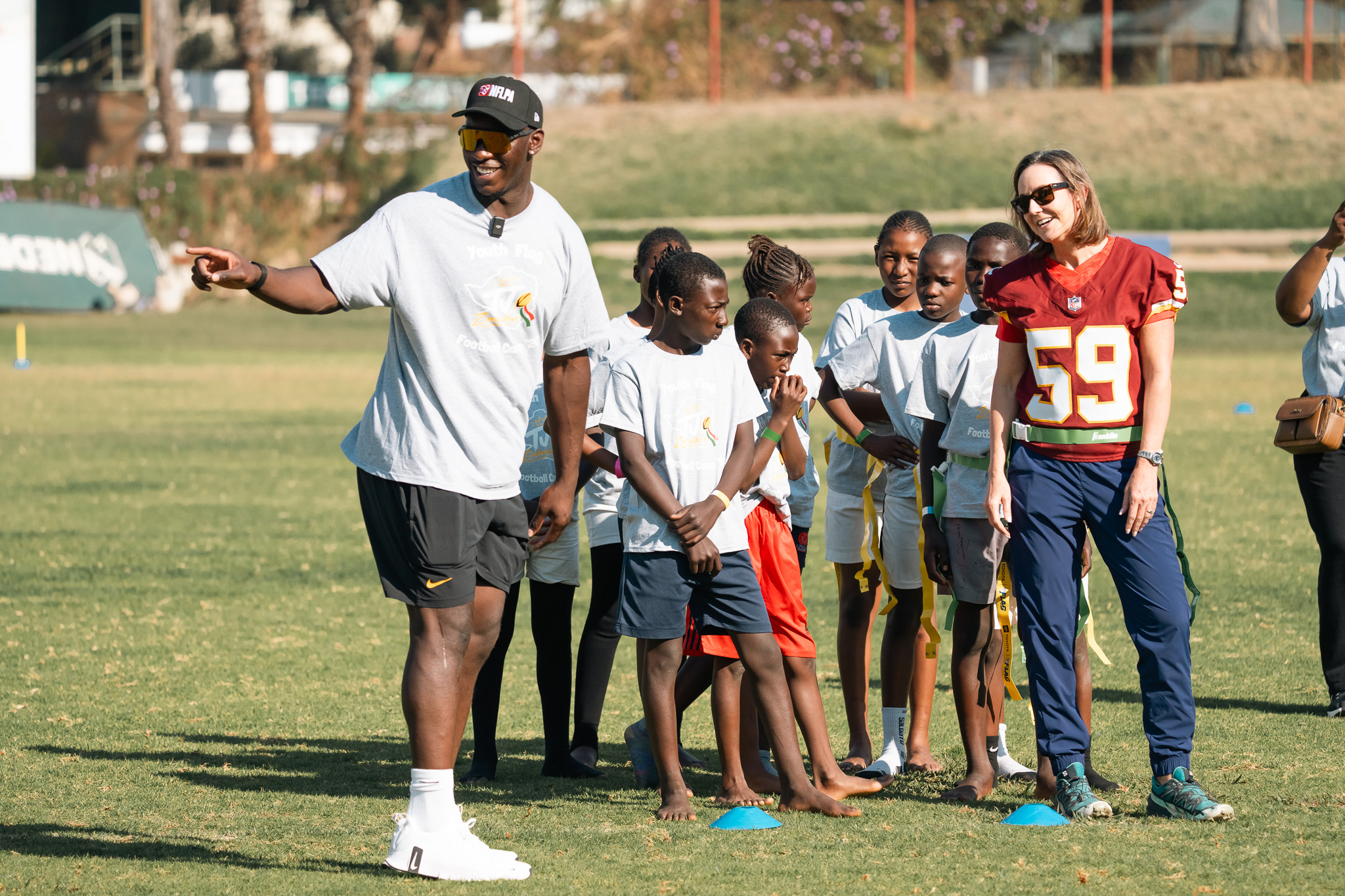
Hailing from Harare, TJ Maguranyanga’s journey towards the National Football League (NFL) in the United States is one of tenacity, hope, and a willingness to charter the unknown. Back home, the 6-foot-4 edge rusher hopes to bridge these two unconnected but, increasingly, parallel worlds.
TJ Maguranyanga may have NFL minutes under his belt, featuring in a nail-biting exchange for the Washington Commanders against the Denver Broncos in late 2025, but it wasn’t until 12 months before his debut that he first threw on a helmet and shoulder pads.
Armed with the experience of playing professionally in rugby, an equally aggressive game with none of the safety gear, in both South Africa and France, the 23-year-old opted into the NFL’s International Player Pathway Program (IPP) for a 10-week training camp program.
Despite it being unfamiliar territory, the Washington Commanders saw enough, signing him as a defensive end in April 2025.
Fast-forward to today, Maguranyanga has emerged as a promising prospect in the sport–and one who is, now, laying the foundation for the next generation of Zimbabweans.

Recently, Maguranyanga held the nation’s first youth player-led NFL clinic at Harare Sports Club.
“Giving back to my country is big for me,” he tells FORBES AFRICA. “There is talent all over that just don’t have the access to succeed.”
As jubilant kids laughed and ran around, it was the first time many had heard of the NFL, let alone touched an American football, Maguranyanga admits, before acknowledging that the intention behind last week’s boot camp extended far beyond the game.
“This initiative isn’t just about teaching flag football; it’s about showing young people that their circumstances don’t define their future…through sport we’re teaching leadership, discipline, teamwork, and resilience, and those skills are used in everyday life,” he says.
“My hope is that children walk away believing that they have a greater chance at success in life,” adds Maguranyanga, before mentioning his desire to make this an annual event.
Fittingly, Maguranyanga’s philanthropic efforts coincide with the NFL’s attempt to extend its reach through the IPP, while hosting league games in Europe. More so, it comes at a time when sports are being positioned as a viable source of soft power.
Having recently completed the refurbishment of its multi-purpose national sports stadium, and in preparation to host the 2027 One Day International (ODI) Cricket World Cup along with South Africa and Namibia, the southern African nation is seemingly planting the seeds to yield wealth through sports.
This strategic shift was evident during Maguranyanga’s flag football initiative, which also featured a sports, technology and business reception, attended by business leaders and diplomats “to speak about how we can use sport to drive the economy”.
The NFL–a game expanding internationally–reported $23 billion in revenue after the 2024-25 season, a rise it hopes will continue, with league commissioner, Roger Goodell targeting $25 billion by 2027.

While there may be a scarcity in homegrown NFL talent, Africa and the league share a long, illustrious relationship.
The reigning Offensive Player of the Year is Super Bowl winner Jaxon Smith-Njigba, born in Texas but rooted in Sierra Leonean heritage.
Moreover, retired British-Nigerian Osi Umenyiora holds two Super Bowl championship titles, while current wide receiver, Rome Odunze, from Las Vegas and of Nigerian descent, is making a name for himself in the sport.
Providing a gauge of the region’s current influence in the NFL, Maguranyanga says: “There are so many African players,” before touching on the inevitability of seeing a player of African heritage on each week’s highlight reels.
As grassroots initiatives become more frequent across the continent, providing gateways to marginalized communities, there’s every reason to believe that a shift in mindset could unearth an abundance of African stars ready to excel on the sports’ biggest stages.
The Daily Brief
Get the daily FORBES.NG briefing.
Comments (0)
Sign in to join the conversation.
Related Stories

Businesses Are Investing in AI but Struggling to Measure Its Returns
Turning AI pilots into measurable business value requires clear objectives, reliable baselines and disciplined oversight.

Why Businesses Need More Than AI Tools to Compete
Technology alone does not guarantee business results; strategy, staff capability, trustworthy data and measurable goals shape the value of AI.

AI Agents Could Transform Digital Payments, but Trust Remains Essential
Automated tools may streamline payment journeys, but security, consumer consent and clear accountability will shape adoption.
More from Freddie Hiney

Zambia Prepares For El Niño After Previous Droughts Triggered Blackouts
The drought over two years ago had catastrophic consequences for Zambia’s energy security–a nation largely dependent on hydropower, generating over 80% of its electricity, according to government figures. As rivers dried up, the number of blackouts rose. The arriving El Niño—widely expected to become one of the strongest on record and anticipated to grapple the …

‘Thinking Five Years Ahead’: Ethiopia’s $50 Million Bet To Become Billion-Dollar Regional Gold And Metals Hub
Inaugurated on October 10, Ethiopia’s National Precious Metals Refinery coincides with gold’s rising importance for the nation of nearly 140 million people. According to the National Bank of Ethiopia, gold exports rose from $133.6 million in the fourth quarter (Q4) of 2023/24 to $1.29 billion in Q4 2024/25. Welcomed as Ethiopia’s first gold refinery, and …
Interest Rate Rises In South Africa, Experts Evaluate Possibility Of Recession
The financial toll of the ongoing global energy crisis is becoming increasingly apparent for Africa’s biggest economy. On Thursday, the South African Reserve Bank (SARB) announced its decision to increase the interest rate by 25 basis points to 7%, a week after year-on-year head inflation hiked to 4%, up from 3.1% in March. Offering some …
Recommended


The Daily Brief